Frequently Asked Questions
-
Running of the Wools celebrates a defining piece of our region’s history that connects agriculture, industry, and national events.
In the years surrounding the American Civil War, wool became an essential material as cotton supplies were disrupted. In response to growing demand, many producers shifted toward high-volume production.
Farmers in Washington County, Pennsylvania took a different approach. Rather than crossbreeding their sheep for mass production, they chose to maintain the quality of their flocks. That decision preserved the integrity of their wool and established the region as a leading producer of high-quality fiber. By the late 19th century, Washington County was recognized as one of the top producers of fine wool in the world.
Running of the Wools builds on that legacy. The festival brings this history into the present through a public, engaging experience that connects people to the animals, materials, and agricultural decisions that shaped the region.
The sheep you see at the festival reflect that same tradition. They are breeds that have been carefully maintained over time for their unique qualities rather than replaced by higher-volume alternatives. Their presence is a reminder that the choices farmers make, then and now, continue to shape the land, the products we use, and the stories we carry forward.
What may look like a simple sheep race is rooted in a much deeper story, one of quality over quantity, continuity over time, and the long relationship between land, animals, and community.
-
Wool is one of the oldest and most versatile natural fibers in the world. It has been used for thousands of years for clothing, insulation, and textiles, and it continues to be valued today for its durability, breathability, and sustainability.
Unlike synthetic materials, wool is renewable, biodegradable, and produced through ongoing agricultural practices. It represents a direct connection between land, animals, and people.
In our region, wool is also part of a larger story about farming, trade, and local economies. By highlighting wool, we are highlighting the systems and skills that support it.
-
A heritage breed is a traditional breed of livestock that was developed over time to thrive in specific regions and farming conditions.
These breeds were shaped by farmers for qualities like hardiness, adaptability, and the ability to live and produce in real-world environments, not just for maximum output.
Many heritage breeds have declined as industrial agriculture has shifted toward a small number of highly specialized breeds. Organizations like The Livestock Conservancy track and support these animals to ensure they are not lost.
All of the sheep participating in the Running of the Wools are heritage breeds.
-
Heritage breeds carry genetic diversity that is critical for the future of agriculture. They are often more resilient to changing climates, diseases, and varied landscapes than highly specialized modern breeds.
They also represent living history. Each breed reflects generations of farming knowledge, regional adaptation, and cultural identity.
When a breed disappears, we lose more than an animal—we lose options for the future, connections to the past, and part of the story of how people lived and worked on the land.
Supporting heritage breeds means supporting the farmers who raise them and helping ensure these animals remain part of a working, living landscape.
-
Running of the Wools brings heritage breeds into the public eye in a direct and engaging way. By showcasing these animals in front of thousands of people, the festival helps build awareness, appreciation, and demand.
That visibility matters. The long-term survival of heritage breeds depends on people understanding their value and supporting the farmers who continue to raise them and the artists and makers who prioritize their fiber.
The festival is one small but meaningful part of that larger effort.
-
No. The safety and well-being of the animals is the top priority of the Running of the Wools.
The sheep participating in the race are handled by experienced farmers and are accustomed to being around people, noise, and activity. The race itself is very short and is designed to move the sheep in a natural way, similar to how they would be guided in a pasture or along a fence line.
There is no chasing, rough handling, or forced running. The sheep move as a group, guided by their natural instincts and by people they are familiar with.
Throughout the event, the animals have access to appropriate space, rest, and care, and their participation is carefully managed by the farmers who know them best.
If a sheep doesn’t want to run, it doesn’t run…and that’s part of the fun!
-
For the safety of the sheep, handlers, and other visitors, we ask that dogs not be brought to Running of the Wools.
Sheep are prey animals and are highly sensitive to dogs, even the best-behaved ones. The presence of a dog can cause unnecessary stress and disrupt the animals, particularly in an active event environment.
Service animals are, of course, welcome.
We appreciate your understanding as we prioritize the well-being of the animals that make this event possible.
-
Running of the Wools takes place rain or shine. Sheep are naturally well adapted to wet weather, and the event is designed to proceed safely in typical conditions.
We encourage visitors to dress appropriately for the weather and plan accordingly.
-
Running of the Wools takes place along South Main Street and under the Community Pavilion in Washington, Pennsylvania.
The event is held on a paved street with a gradual slope. While the incline may require some additional consideration, the area can accommodate wheelchairs and other mobility aids.
We encourage visitors with specific accessibility needs to plan accordingly, and we are committed to making the event as welcoming and inclusive as possible.
-
No. Running of the Wools is free and open to the public.
-
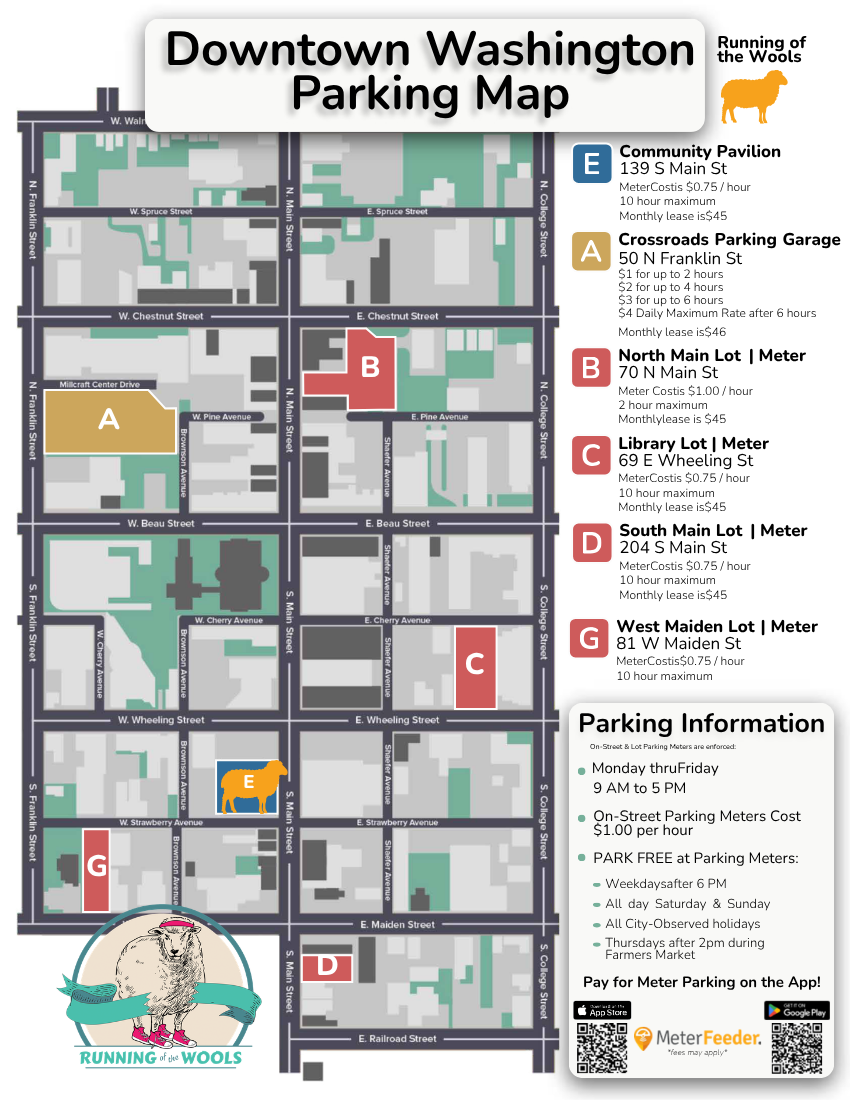
See map below.